
A framework for Founders and CEOs
The Three pillars of
Business
growth
Build trust, pricing power, and lasting growth by solving what actually matters.
May 7, 2026
Most growth advice tells you to optimize what you already have. Run more ads. A/B test your landing page. Squeeze another few percentage points out of conversion.
That's fine for incremental gains. But if you're trying to build something that compounds, something that gets stronger the longer it runs, you need a different operating system.
That's what the Three Pillars framework is. I developed it by building on Jay Abraham's foundational work on the Three Ways to Grow a Business and refining it through years of direct work with founders and product teams. Jay and I are now writing the book together: The Three Pillars of Business Growth: Insight & Innovation on the Path to Preeminence.
The premise is simple: sustainable growth isn't about doing one thing well. It's about aligning three forces that, when they work together, create geometric returns. Not incremental. Geometric.
Here's how it works.
“Preeminence is the strategy of being so singularly focused on your customer’s well-being that they would never consider going anywhere else.”
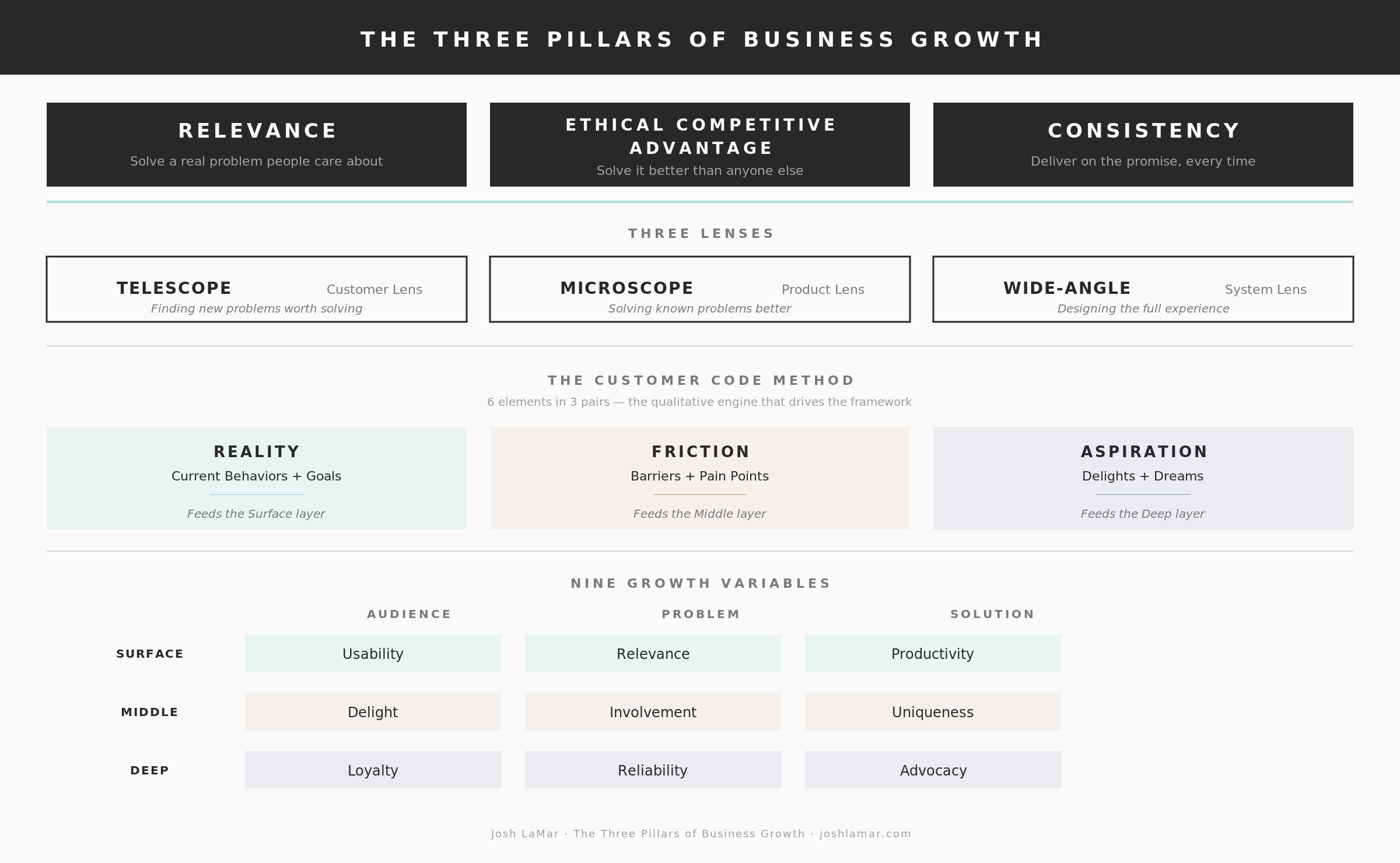
The Framework at a Glance
Three Pillars x Three Lenses x The Customer Code
PILLAR 1: THE TELESCOPE
Relevance
Solve a real problem people actually care about.
This is where most businesses think they're strong. And where most businesses are wrong. They build what they know how to build, not what the customer actually needs solved.
Relevance is about looking outward. It's the Telescope lens: scanning the landscape for the problems that genuinely matter to the people you serve. Not what you wish they cared about. Not what your product roadmap says they should care about. What they actually lose sleep over.
The Customer Code Method starts here. Before you can build anything worth buying, you need to understand your customer's Reality: their current behaviors and goals. What are they doing today? What are they trying to achieve? Where is the gap between the two?
When you get this right, you earn a kind of trust that marketing alone can never buy. Your customer feels understood, not just sold to. And that understanding becomes your foundation for everything that follows.
Questions to Reflect on
Does your product solve a problem your customer would describe in their own words?
How frequently does this problem occur in their daily life or work?
If your solution disappeared tomorrow, how urgently would they look for an alternative?
Are you building for the market as it is, or as you hope it will be?
How we apply this
Telescope Innovation means finding new problems worth solving. Not incremental improvements to existing solutions, but discovering unmet needs your competitors haven't noticed yet. This is the work of deep customer research, behavioral observation, and honest listening. The Customer Code gives you a structured way to do it.
Pitfall to avoid: Falling in love with your product instead of falling in love with your customer's problem. When you build from the inside out, starting with your capabilities instead of their needs, you end up solving problems nobody has.
PILLAR 2: THE MICROSCOPE
Ethical Competitive Advantage
Solve it better than anyone else. Without cutting corners.
Once you know you're solving the right problem, the next question is: can you solve it in a way that nobody else can match?
This is the Microscope lens. You zoom in. You study the mechanics of your solution at the granular level. Not to add more features, but to find the places where deeper craft, better design, or genuine innovation creates an advantage your competitors can't easily replicate.
The word “ethical” matters here. This isn't about locking customers in with switching costs or burying competitors with unsustainable pricing. Ethical competitive advantage means your customers choose you because you're genuinely better. And they stay because the value is real.
This is where the Customer Code's Friction pair becomes essential. What barriers stand between your customer and their goal? What pain points does your current solution create? When you understand friction deeply, you don't just solve the problem. You solve it in a way that feels effortless to the person on the other side.
Questions to Reflect on
What can you do for your customers that no one else in your market is willing or able to do?
If a competitor copied your product feature-for-feature, what would you still have that they wouldn't?
Where in your customer's experience are they tolerating friction because they've accepted “that's just how it works”?
Is your advantage something customers would describe as valuable, or just something you're proud of internally?
How we apply this
Microscope Innovation means solving known problems in fundamentally better ways. It's the difference between adding a feature and rethinking the experience. Jay calls it being so good at what you do that your customer would feel it was a disservice to themselves to go anywhere else. That's the standard.
Pitfall to avoid: Confusing differentiation with complexity. More features don't make you different. Sometimes the most competitive thing you can do is simplify: strip away everything that doesn't directly serve the customer's core need.
PILLAR 3: THE WIDE-ANGLE
consistency
Deliver on the promise, every single time.
This is the pillar that most people skip. And it's the one that determines whether you build a real business or just have a good product.
Consistency is the Wide-Angle lens. You step back and look at the entire system: the full arc from the promise you make in your marketing to the experience you deliver in your product to the relationship you maintain after the sale. The question is whether all three of those things align.
I call this Negotiated Product Truth. It's the alignment between what the customer needs, what your marketing promises, and what your product actually delivers. When those three are in sync, trust compounds. When they're out of alignment, even slightly, trust erodes. And once trust erodes, no amount of ad spend brings it back.
The Customer Code's Aspiration pair lives here. What delights your customer? What do they dream about? The gap between “what you promised” and “what they got” is either your greatest liability or your greatest asset. Consistency is the discipline of closing that gap, every single time.
Questions to Reflect On
Does your product deliver on what your marketing promises, or does it over-promise and under-deliver?
If you asked your best customer to describe your product to a friend, would it match your marketing copy?
Are the people who buy your product once coming back? If not, where does the experience break down?
Could someone experience your brand across five different touchpoints and feel like it was all one company?
How we apply this
Wide-Angle Innovation means designing the full customer experience as a coherent system. It's not about a single feature or a single campaign. It's about ensuring that every touchpoint, from first impression to long-term relationship, delivers on the same promise. When your system delivers consistently, every happy customer becomes an unpaid evangelist. That's the compounding engine.
Pitfall to avoid: Treating marketing and product as separate teams solving separate problems. The moment your marketing says one thing and your product delivers another, you've broken the trust cycle. And trust is the only asset that compounds.
The geometry of growth

Here's the part that changes everything: these three pillars don't just add up. They multiply.
Most businesses improve one area at a time. Better marketing. Better product. Better retention. And each improvement helps. A little. Incrementally.
But when you improve all three pillars simultaneously, even by modest amounts, the gains don't stack linearly. They compound geometrically. A 20% improvement across Relevance, Ethical Competitive Advantage, and Consistency doesn't produce 60% growth. It produces something closer to 73%.
1.2 × 1.2 × 1.2 = 1.728
This is why some businesses seem to break away from the pack while their competitors fight for scraps. They didn't find a silver bullet. They aligned multiple forces that reinforce each other. The Nine Growth Variables give you a way to measure this alignment across nine dimensions, three for each pillar, so you can see exactly where the compound effect is working and where it's leaking.
Growth doesn't come from doing one thing better. It comes from doing the right things together.
The Three Pillars of
Business Growth
Insight & Innovation on the Path to Preeminence
Everything on this page, and much more, is explored in depth in the upcoming book. You'll find the complete Customer Code Method, the Nine Growth Variables measurement instrument, detailed case studies across industries, and a module-by-module system for applying geometric growth to your business.
By Josh LaMar & Jay Abraham · Coming Soon
Want to run
this diagnostic on
your business?
Let's apply the Three Pillars framework to your specific situation and find the compound growth opportunities hiding in your business.