
February 26, 2026 | Josh LaMarThe crisis
information design
framework
A three-layer model for designing trust when it matters most.
The Problem
AI-generated content is now photorealistic, instantly shareable, and weaponized during crises. The platforms people depend on for survival information have no design infrastructure to help them separate real from fake.
The tools to verify content exist. C2PA can prove provenance. SynthID can detect AI-generated images. Fact-checkers can debunk claims within hours. But none of these tools reach people at the moment they need them most.
That's not a technology problem. It's a design problem.
The Crisis Information Design Framework gives designers and product teams a structured way to close that gap.
The Three Layers
Layer 1: The Verification Gap DIAGNOSE
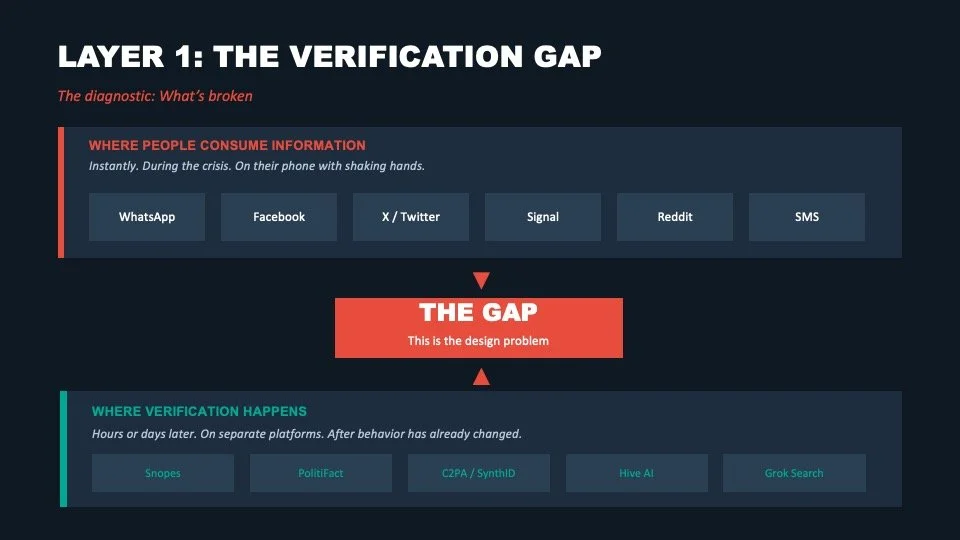
The spatial and temporal gap between where people consume information and where verification happens.
During a crisis, consumption is instant. Verification arrives hours later, on a completely different platform. That gap is where misinformation does its damage.
The design question:
Is verification visible at the point of consumption?
Layer 2: Information Hierarchy of Needs PRIORITIZE
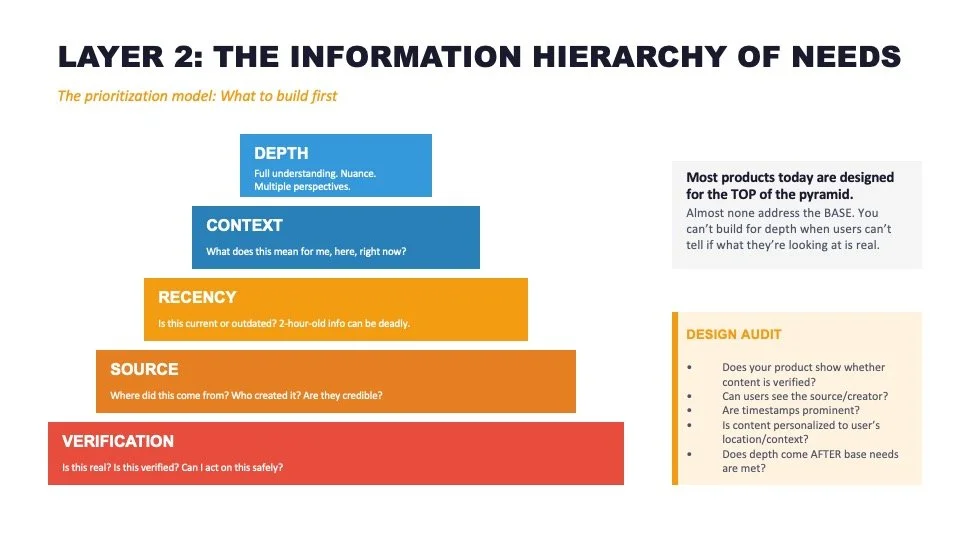
A Maslow-inspired model for crisis information. Five levels, built from the base up: Verification, Source, Recency, Context, Depth.
Most products today design for the top of the pyramid. Almost none address the base. You can't design for depth when users can't tell if what they're looking at is real.
The design question:
Does your product serve the base before the top?
Layer 3: Trauma-Informed Information Design EXECUTE
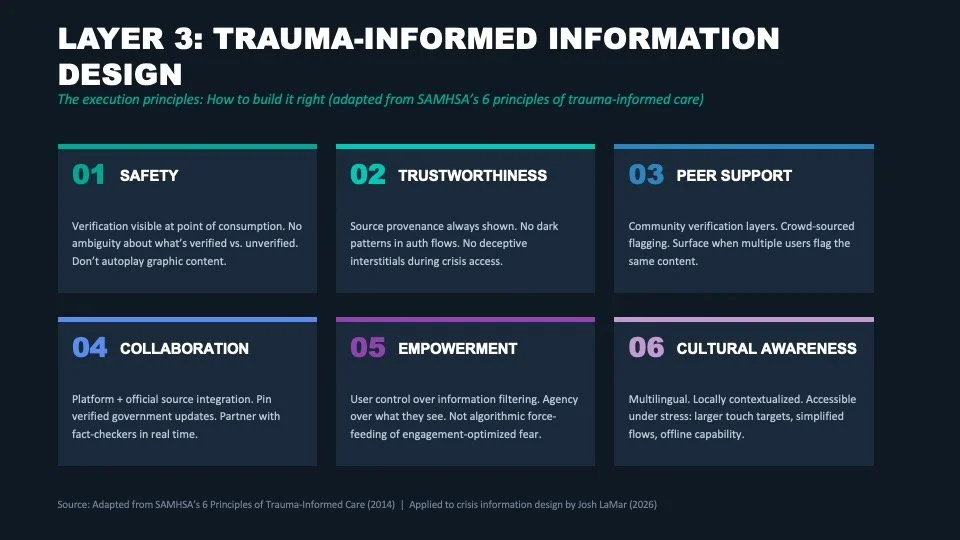
SAMHSA's six principles of trauma-informed care, adapted for digital products during crisis: Safety, Trustworthiness, Peer Support, Collaboration, Empowerment, and Cultural Awareness.
Because designing for someone whose hands are shaking and who hasn't slept requires a fundamentally different approach.
The design question:
Is your product safe for someone making survival decisions?
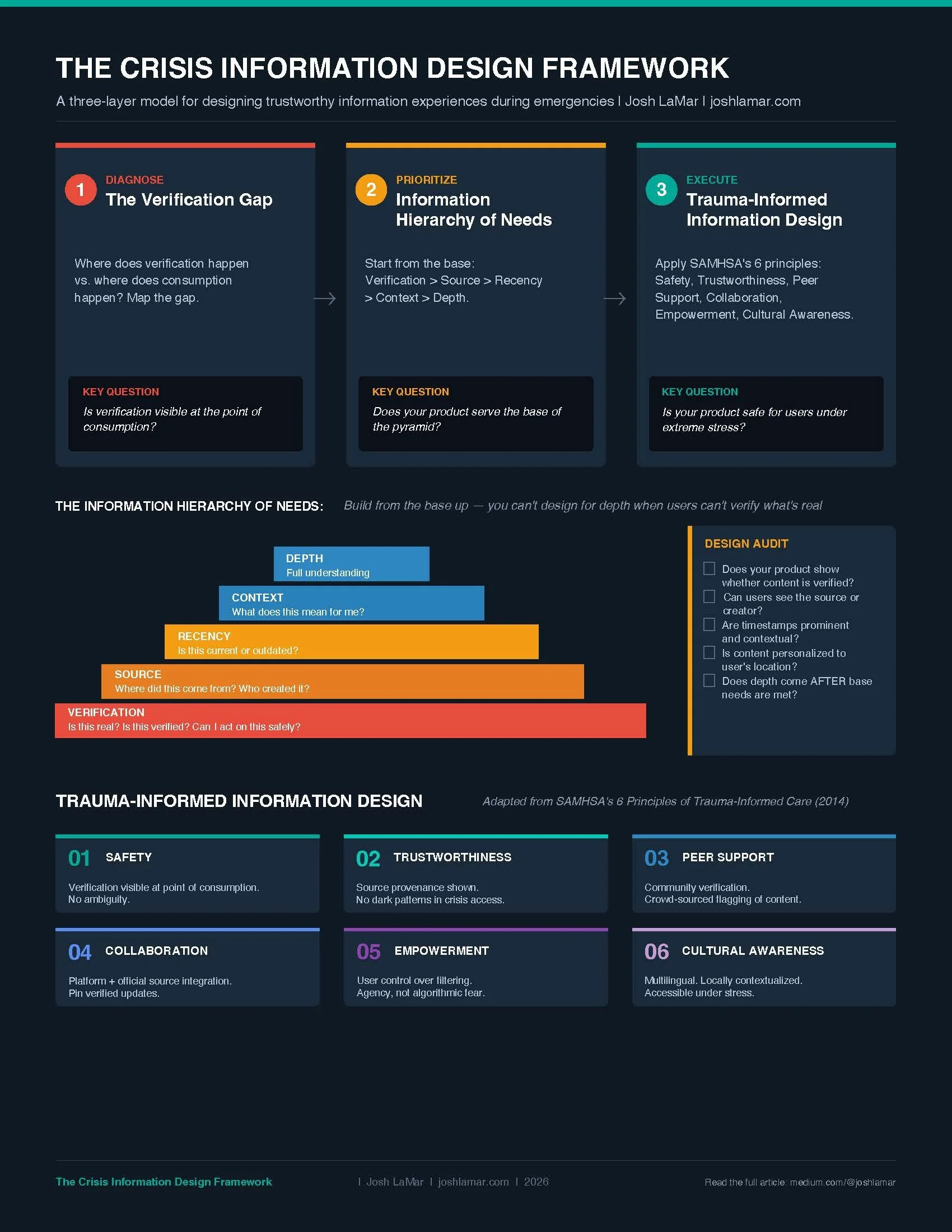
Download the
One-Page Framework
Cheat Sheet
A printable reference with all three layers, the Information Hierarchy of Needs pyramid, a design audit checklist, and the six trauma-informed design principles.
Pin it to your wall.
Bring it to your next design review.
Share it with your team.
Read the
Full Article
"The UX of Survival" is published on Medium. It walks through the full framework, the research behind it, a real-world case study from the February 2026 crisis in Mexico, and specific recommendations for messaging platforms, news organizations, and social products.
About Josh
Josh LaMar is CEO of Amplinate, where he advises on product growth and AI decision strategy. Over 20 years, he has spent 40,000+ hours listening to customers across 19 countries on five continents. He lives between Puerto Vallarta and Paris.
More Frameworks
Subscribe on Substack
Follow Josh on LinkedIn
